The marshmallow test, revisited
A famous experiment seemed to show that waiting for a second treat predicts success in life. Larger and cleverer studies, decades later, told a more interesting story — one that has a lot to say about money.
29 September 2026 · 6 min read
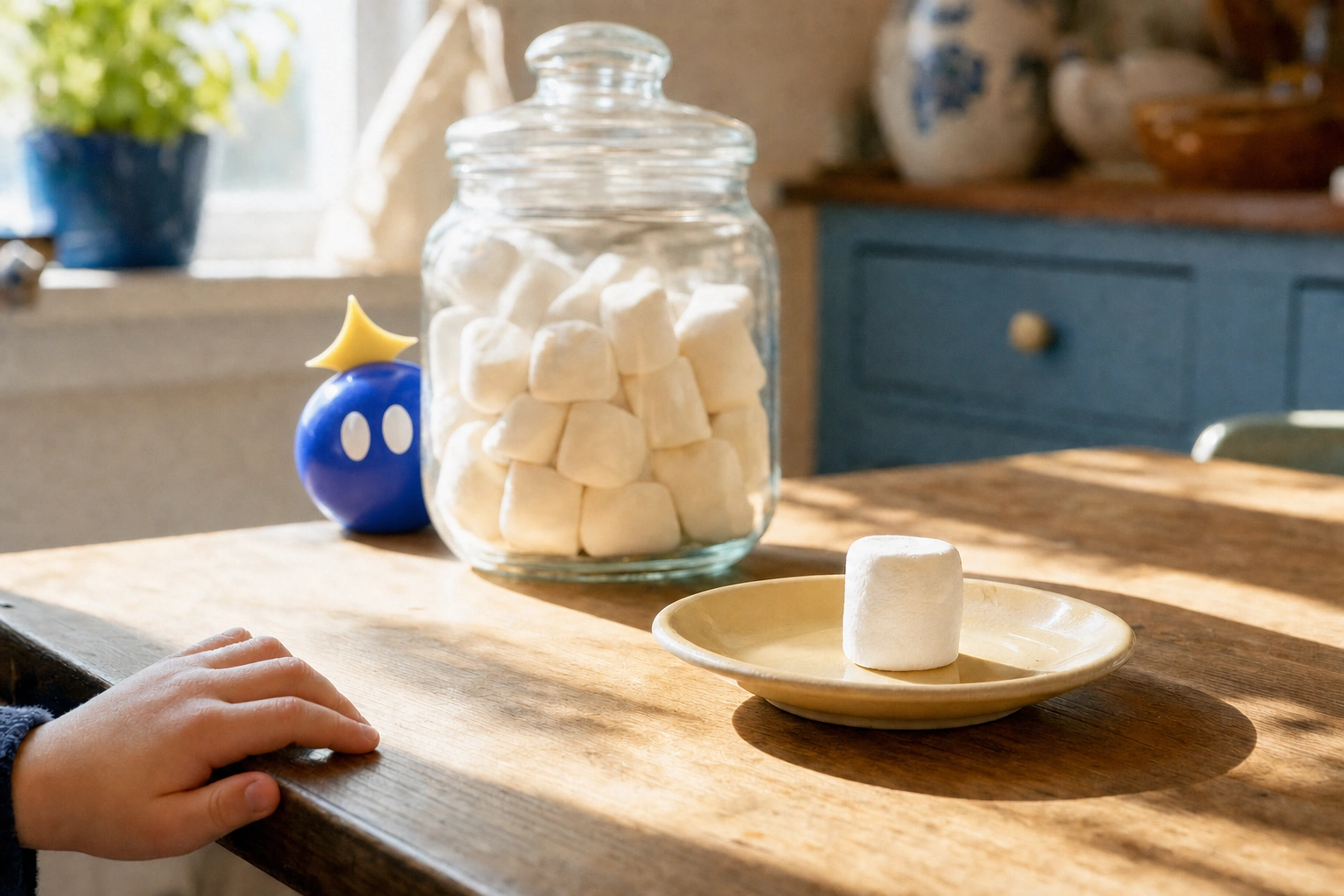
In the late 1960s, the psychologist Walter Mischel and his colleagues at Stanford University began a series of experiments at the Bing Nursery School on the university campus. The set-up was simple enough to fit on an index card. A child, usually four or five years old, sat at a table. On it was a small treat — a marshmallow, a pretzel or a cookie, depending on what the child liked.
The researcher made an offer. They had to leave the room for a while. If the child waited until they came back, they would get two treats. If they could not wait, they could ring a bell at any time; the researcher would return, and the child could eat the one treat in front of them — but would not get the second.
Then the adult left, and the waiting began.
What the children did
Some ate the treat almost at once. Others held out for the full time, often around fifteen minutes. The interesting part, for the researchers, was how they managed it. Children who waited longer tended to find ways not to think about the treat: they covered their eyes, turned their chairs, sang to themselves, kicked the table or invented games. Children who stared at the marshmallow, or thought about how sweet and chewy it would be, found the wait much harder.
Mischel’s early papers were mostly about these strategies — about how attention and imagination shape self-control. The idea that made the experiment famous came later.
A story that grew
More than a decade after the original sessions, Mischel and colleagues contacted families of the children who had taken part. In papers published in 1988 and 1990, they reported that the children who had waited longer as preschoolers were described by their parents as more competent teenagers, and tended to have higher SAT scores.
The finding travelled far beyond psychology. It became a lesson about willpower, a parenting tip, a talking point in business books and a way of explaining money: people who can wait, the story went, are the ones who save, invest and get ahead. The image of a small child staring at a marshmallow turned into a shorthand for character.
But the follow-ups had real limits. They included only a few dozen children, all of whom had attended one nursery school on the campus of an elite university. Many of their parents were Stanford staff or students.
What a bigger study found
In 2018, researchers Tyler Watts, Greg Duncan and Haonan Quan published a “conceptual replication” in the journal Psychological Science. Instead of a few dozen children from one nursery school, they drew on a large American study of child development that had followed around 900 children from many different backgrounds, including a version of the marshmallow test at age four and a half.
Waiting still went with later achievement at age fifteen — but the link was about half as strong as in the original reports. And once the researchers accounted for factors such as family background, the home environment and the child’s early cognitive abilities, most of the remaining link disappeared.
In other words, the ability to wait at four was partly a sign of the child’s situation — the resources and stability around them — and not only a fixed piece of their character that set the course of their life.
The crayons experiment
A few years earlier, a study by Celeste Kidd, Holly Palmeri and Richard Aslin at the University of Rochester had added an elegant twist. Before the marshmallow test, children were given an art project and a small, well-used box of crayons. A researcher promised that if they waited, she would bring a bigger, better set.
For half the children, she kept her promise and came back with the new art supplies. For the other half, she returned empty-handed and apologised. The same thing happened again with a promise of better stickers. Only then did the children face the classic marshmallow test.
The children who had just met a reliable adult waited, on average, about four times longer — around twelve minutes, against roughly three for those who had met an unreliable one. The researchers published the paper with the title “Rational snacking”.
“Children’s wait-times reflected reasoned beliefs about whether waiting would ultimately pay off.”
Seen this way, eating the first marshmallow is not always a failure of willpower. If experience has taught you that promises are often broken, taking what is on the table is a perfectly sensible choice.
Why it matters for money
Adults are not so different from those children. Putting money aside for later is a bet that later will arrive more or less as promised. It is much easier to make that bet when your income is steady, your rent is predictable and a small emergency will not tip everything over.
The economist Sendhil Mullainathan and the psychologist Eldar Shafir explored this in their book Scarcity (2013). They describe how running short — of money, but also of time — captures attention and narrows it to the problem right in front of us. People under that kind of pressure are not less capable; they are busier, mentally, with the urgent. Long-term plans get pushed to the edges.
This does not mean that habits and strategies do not matter. Mischel himself spent much of his career showing that they do: children who distracted themselves waited longer, and adults can learn similar tricks. But it does change the story we tell about people who struggle to save. Sometimes the problem is not the person in front of the marshmallow. It is how believable the second marshmallow is.
Hot thoughts and cool thoughts
Mischel spent decades on the question of how waiting works. With the psychologist Janet Metcalfe, he described two ways the mind can treat a temptation. A “hot” system responds quickly and emotionally to what is in front of us — the sweetness, the smell, the urge. A “cool” system is slower and more reflective: it can think about the treat as an object, a rule or a story.
The children who waited longest were often the ones who found ways to cool things down. In some versions of the experiment, children were told to imagine the marshmallows as fluffy clouds, or to picture a frame around them as if they were a photograph. Those small changes in how they thought about the treat made waiting noticeably easier.
When saving does not rely on willpower
Behavioural economists have taken a similar idea in a practical direction: if waiting is hard in the moment, design things so that the moment never comes. In a well-known programme called Save More Tomorrow, the economists Richard Thaler and Shlomo Benartzi invited employees to commit in advance to putting part of their future pay rises into their pension.
Because the extra saving only started when a raise arrived, nobody saw their take-home pay fall. In the first company to try it, described in a 2004 paper in the Journal of Political Economy, average saving rates among participants rose from about 3.5 per cent of salary to 13.6 per cent over about 40 months.
The striking thing about the result is how little it asked of willpower. The decision was made once, when it was easy, and then left to run.
A gentler question to ask
If you find yourself thinking “I just have no willpower with money”, the research suggests a kinder and more useful question: what would make the future feel more reliable to me right now? For some people that is a small buffer that makes surprises less frightening. For others it is simply seeing, regularly, that the money set aside last month is still there.
Fifty years after the first children sat down with a marshmallow, the experiment is still teaching us something — just not quite what we first thought.
Sources
- Walter Mischel, Ebbe B. Ebbesen, “Attention in delay of gratification”, Journal of Personality and Social Psychology 16 (2), 1970
- Yuichi Shoda, Walter Mischel, Philip K. Peake, “Predicting adolescent cognitive and self-regulatory competencies from preschool delay of gratification”, Developmental Psychology 26 (6), 1990
- Tyler W. Watts, Greg J. Duncan, Haonan Quan, “Revisiting the Marshmallow Test”, Psychological Science 29 (7), 2018
- Celeste Kidd, Holly Palmeri, Richard N. Aslin, “Rational snacking”, Cognition 126 (1), 2013
- Sendhil Mullainathan, Eldar Shafir, Scarcity: Why Having Too Little Means So Much, Times Books, 2013
- Janet Metcalfe, Walter Mischel, “A hot/cool-system analysis of delay of gratification”, Psychological Review 106 (1), 1999
- Richard H. Thaler, Shlomo Benartzi, “Save More Tomorrow”, Journal of Political Economy 112 (S1), 2004
More to read
 ThinkingThe ox that made a statistician change his mindIn 1906, nearly 800 people guessed the weight of an ox at a country fair. The man who collected the tickets expected nonsense. He got something else — and so did everyone who has studied crowds since.2 October 2026 · 7 min read
 CommunicationTwo hours, two minutes: the speech nobody came to hearAt Gettysburg in 1863, the main speaker talked for two hours. The president, invited to add a few remarks, used about 270 words. Here is what that afternoon can teach anyone who writes or speaks.25 September 2026 · 6 min read
 RelationshipsWhy we misread the people we know bestWe expect our partners and close friends to understand us almost without words. A series of clever experiments suggests we expect too much — and offers a small habit that helps.22 September 2026 · 5 min read